Ten Jazz Standards “Decoded” For Electric Bass, So Your Solo Finally Changes When The Chords Do
One box shape per chord, only one or two notes moving between them, on the ten tunes that actually get called at jam sessions. Played on electric, start to finish.
Even if the pentatonic box is the only scale you really trust.·Even if dominant chords make you freeze.·Even if your solos come out sounding like your bass lines.
▶ Turn your sound on. The whole thing is the difference you hear
Same B♭ blues. Same spot on the neck. Different five notes.
Jazz Standards Decoder
Ten of the most-called standards, decoded one chord at a time for electric bass: Autumn Leaves, Blue Bossa, So What, Freddie Freeloader, Billie’s Bounce, Cantaloupe Island, Summertime, All Blues, Song For My Father, Satin Doll
$144 $27
(Save $117, today only)
Show Me All Ten StandardsInstant digital access🔒 100% Secure Checkout
- Ten video lessons, all on electric bass
- Every box scale for every chord, in the PDF
- Instant access · Lifetime access
- Refund any time, and keep everything
Dear Electric Player,
From: The practice room of Cole Davis
Re: Your solos (this one’s for you)
Surprised to see a $27 price tag on this?
I thought you might be.
Would it surprise you more to learn this is the same system I use on gigs in New York every week, and that the thinking behind it comes out of two years of lessons with Ron Carter?
Skeptical?
You should be. Everybody selling bass lessons says something like that.
So don’t take my word for any of it. Do this tonight instead, whether you buy anything from me or not:
Put on a play-along of a blues in F and take one chorus with the scale you always use. Record it on your phone.
Now listen back and ask one question. In bar five, when the band goes to B♭7, does your solo change? In bar eight, when the piano hits that D7, does it change again?
Play the same test on a Miles record, or Charlie Parker, or Jaco. You’ll hear the line shift every single time the chord does.
Then listen back to yourself. Twelve bars, one box, same five notes all the way through.
That’s not a talent problem, and it’s not a theory problem.
When people ask “what are the changes?” they’re really asking what are the differences? The players you love move one or two notes every time the chord moves. You keep all five notes where they were. That’s the whole difference.
Here’s Exactly What That Sounds Like
Take Autumn Leaves. Over the C minor 7 you’ve got a box with a B♭ in it. The next chord is F7. Keep the same shape, move that one B♭ down a fret to A, and you’re playing the F7.
Play those two notes back to back, just the B♭ and then the A, and it already sounds like the song resolving. Nothing else moved.
Now leave the B♭ where it was and play through the F7 anyway. The notes are all “in the key.” The band is playing a different chord. That’s the moment the keys player glances over.
From lesson one, Autumn Leaves. Listen for the B♭ dropping to the A.
One scale for every chord sounds like a scale. Five scales for every chord sounds like panic. One box per chord, with only one or two notes changing between them, sounds like somebody playing the changes.
I Didn’t Invent Any Of This. It’s How The Changes Work, And I’m Giving You The Whole Rule On This Page
Instead of adding more to your playing, this takes things away.
Here’s what you’ve probably been told to do instead:
- Learn the seven modes, then learn which one goes on which chord.
- Memorize the altered scale, the diminished scale and the bebop scale.
- Transcribe a stack of horn solos and hope some of it sticks.
- Put on a backing track and “just noodle around.”
- Practice arpeggios in all twelve keys until they come out at tempo.
Every one of those is addition. This is subtraction.
You already know the box. You’ve had a pentatonic shape under your fingers for years. The problem was never that you don’t know enough notes. Here’s what it actually gets rid of:
- Dropping into the same pentatonic box the second the sax player points at you, and staying there for the whole tune.
- Starting a solo with a plan and hearing it turn into the same handful of riffs by the second chorus, every single time.
- Cantaloupe Island going to D♭7 while the A♭ you’re leaning on turns sour under the keys player’s voicing.
- Soloing down in the first five frets and hearing a busier version of your bass line come out.
- Running out of ideas halfway through the first chorus of So What.
- The blues being the tune you’ve played longest and solo over worst.
- Knowing A is the third of F7 and still not being able to find it at tempo.
Every solo that stayed stuck in one box wasn’t your fault. The music most of us grew up on, from Michael Jackson to Taylor Swift, runs on major and minor chords. So our ears learned those and skipped the dominant chord, which happens to be what the blues and half the jazz songbook are built on. Then someone handed us seven modes per chord and a backing track. From here it’s a choice.
From lesson one: why your ears go blank on dominant chords.
The rule, free, right now
Only One Or Two Notes Change
Pick one five-note box for each chord. From one chord to the next, change only one or two notes. Never zero, because if nothing changes you’re just running a scale. Never all five, because then it stops sounding like one line.
That’s the entire rule. On the first four bars of Autumn Leaves it means one B♭ turning into an A, and the same shape you played over C minor 7 becoming your E♭ major 7 without moving a finger.
And a box isn’t just any five notes. I pick boxes that start on the 9th, the 13th or the sharp 11, with the other colors sitting one fret outside the shape. That way you’re never more than a half step from a right note.
Here’s The Part That’s Going To Annoy You
You just got the rule. That was it. It took you ten seconds to read.
So go try it tonight. On a blues you’ll get halfway through bar five, reach for the box you always use, and hear it happen anyway.
Because knowing the rule exists and knowing which box goes on which chord are not the same skill. And the ten tunes in this course all ask a different question.
Blue Bossa modulates to D♭ major, and if your box doesn’t modulate with it you’re playing a different song. So What gives you two chords and all the rope in the world, and the obvious scale runs dry in a chorus. Cantaloupe Island sounds like a blues and punishes the blues box. Satin Doll changes chords twice a bar, so there’s barely time to think at all.
Four tunes. Four different answers to the same rule.
The rule is free. Knowing which box goes where is the ten lessons.
Here Are The Ten Standards You’re Decoding
Every one played on electric bass. Every chord gets one box, shown on the neck, with the one or two notes that change marked out, so you can hear the decision and then make it yourself.
- Autumn LeavesMajor and minor 2-5-1s, and the six chords that make up the whole tune
- Blue BossaMaking the modulation to D♭ major actually sound like a modulation
- So WhatTwo boxes per chord, both starting on the 9th, so you don’t run out
- Freddie FreeloaderA B♭ blues with a twist, and an altered box that does the work for you
- Billie’s BounceAn F blues with Lydian dominant color and an altered D7
- Cantaloupe IslandSounds like a blues, isn’t one: F minor 7 to D♭7 to D minor 7
- SummertimeMinor 2-5s and the half-diminished chord nobody can hear
- All BluesA blues in 3/4, all dominant chords, voice leading that falls under the hand
- Song For My FatherFour boxes built around the one note that sits in every chord
- Satin DollTwo chords a bar, handled with one scale, or one scale split in half
You’re not just learning ten songs. These happen to be the ten you’re most likely to get called on at a jam, which helps. But the tunes were never the point. Every one is a case study in a move that works on everything else in the Real Book.
Wanna Know The Difference Between How You Were Taught And What The Changes Actually Ask For?
How Most Of Us Were Taught
- One box for the whole tune
- Seven modes per chord
- Start on the root, stay safe
- Solo in bass-line range
- Treat the blues as the easy one
- More scales = more options
- Noodle and hope
What The Changes Actually Ask For
- One box per chord
- One or two notes change
- Start on the 9th, 13th or sharp 11
- Solo from the middle of the neck
- Respect the dominant chord
- One scale = conviction
- Hear the change, move the note
And the result of doing it this way? Your solo sounds like one line and still changes every time the chord does.
Today
$144 $27
🔒 Secure checkout · Save $117 today only
Three Things This Course Will Not Do For You
It will not give you licks. There’s no lick sheet in here and no bag of patterns to drop over a blues. If that’s what you came for, close the page and keep your money.
It will not teach you upright bass. This one is built for electric players. Every lesson is played on electric, every box is a fret shape, and nobody is going to tell you to go buy a doghouse to play jazz. If you play upright, the thinking carries over, but this wasn’t built for you.
And if you’ve never played a pentatonic box, or you don’t yet know what a 2-5-1 is, this will move too fast. Start with the basics and come back. It’ll be here.
Here’s Everything You’re Getting For Only $27 Today
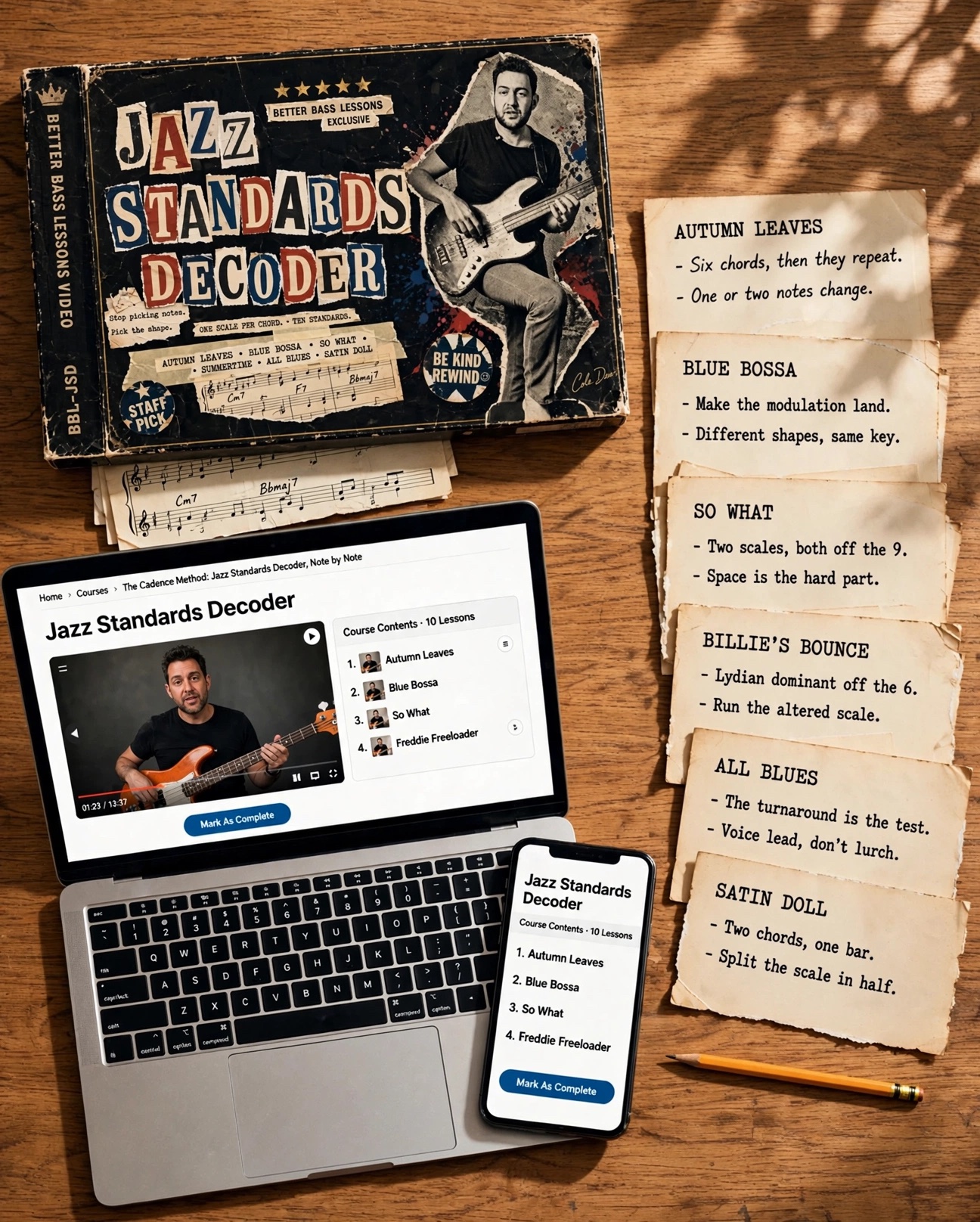
Ten Video Lessons
One lesson per standard, plus an intro to the system. Each chord gets its box on the neck, then Cole solos a full chorus with nothing but those boxes, so you hear exactly how it sounds in context. Watch on anything: laptop, phone, the stand next to your bass.
Value $97 Included
The Box Scale PDF, Free
Every box for every chord of all ten tunes, written out so you can keep it on the music stand instead of pausing the video.
Value $47 Included
Lifetime Access
No subscription and no expiry. Work through one standard a week or binge the whole thing on a Saturday. It’s yours either way.
Included
Just
$27
(Save $117 today)
Get Instant Access For $27All ten lessons + the PDF · Yours for life🔒 Secure checkout · Refund any time, keep everything
I charge $250 an hour to teach this in person. This is about a ninth of one lesson, and you keep it forever.
And Before You Get The “Jazz Standards Decoder”… I Want You To Know There’s No Catch!
I realize this is very inexpensive and that I’m practically giving it away.
So you might reasonably be asking: if you studied with Ron Carter and you charge $250 an hour, why is this $27?
Simple. I’m making this offer with the idea that you’ll be impressed with what you get today, and that you’ll want to do more training with me down the road. That’s the whole reason. I’d rather you found out how I teach for the price of a couple of drinks than never found out at all.
There’s no trial that rolls into a subscription. You pay once, and you have it for life.
★ The boldest guarantee I know how to make ★
Take One Of These Tunes To Your Next Jam. Just One.
If your solo doesn’t sound different, email me and I’ll refund every dollar, and you keep the videos and the PDF. I won’t make you delete anything, fill out a form, or explain yourself. There’s no time limit on it either.
I can do that because I know what happens when a player finally hears one note move with the chord. You don’t un-hear it. You start catching it on every record you own.
You can close this page and keep playing the same box over every chord. Most jams will let you. But you’ll hear it, every time the band changes chords and your solo doesn’t.
Or you can spend $27 and know exactly which note to move, on ten of the tunes you’re most likely to get called on, and on that recording of yourself you didn’t want to finish.
Play what you hear,
Cole Davis
Better Bass Lessons
P.S. Short version, for anyone who scrolled. Ten of the most-called jazz standards, decoded for electric bass, one box scale per chord with only one or two notes changing between them, in ten video lessons plus a PDF of every box. It’s the difference between a solo that sits in one scale and a solo that plays the changes. $27, instant access, lifetime access. If your solos don’t sound different I’ll refund you and let you keep everything, no time limit.
P.P.S. Do the test tonight whether you buy or not. Record one chorus of a blues in F and listen for bar five. If your solo doesn’t change when the chord does, that’s what these ten lessons are for. If it does, you already know what it’s worth.
Frequently Asked Questions
❓ I want this. What exactly am I getting?
Ten video lessons, one per standard, plus an intro to the system, and a PDF with every box scale for every chord. Instant access, lifetime access, yours the moment you order.
❓ Is this for electric or upright?
Electric. Every lesson is played on electric bass and every box is a fret shape. Upright players can use the thinking, but the fingerings were built for frets.
❓ Won’t thinking in scales make my solo sound like math homework?
It does when you’re juggling five scales per chord at tempo. That’s the freeze. Here it’s one shape per chord, already under your hand, and the only decision is which one or two notes move when the chord changes. You stop calculating and start hearing the change.
❓ Do I need a five-string?
No. Cole plays a five-string in the lessons, and where the low B helps he shows you the four-string version of the same spot. Everything sits in the middle of the neck, where a four-string has every note you need.
❓ What skill level do I need?
You should already know at least one pentatonic box and roughly what a 2-5-1 is. If you can do that, you’re ready. If you’ve never improvised at all, start somewhere simpler first.
❓ Do I need to read music?
No. Every box is shown on the neck on video and played before it’s written down. The PDF is there so you don’t have to keep pausing.
❓ How long until I hear a difference?
Most players hear it the first night, because the change is in which note you move, not in what your hands can do. You could watch the whole course in an afternoon, though I’d rather you took one tune a week.
❓ Is this a subscription?
No. One payment, lifetime access, and no trial rolling into anything.
Ten Jazz Standards, Decoded For Electric Bass
Today
$144 $27
🔒 100% Secure Checkout · Save $117 today only
Results vary and depend entirely on the work you put in. Nothing here is a promise that you will play like Jaco Pastorius, Miles Davis, or anyone else named on this page. This is an electric bass course; all ten lessons are played and demonstrated on electric bass. It teaches a system for choosing one scale per chord on ten recorded standards, and what you do with it in the practice room is up to you.